A Week of Growth: CTTC Club Wraps Up Seven Days of Intensive Match Play(20260413-19)
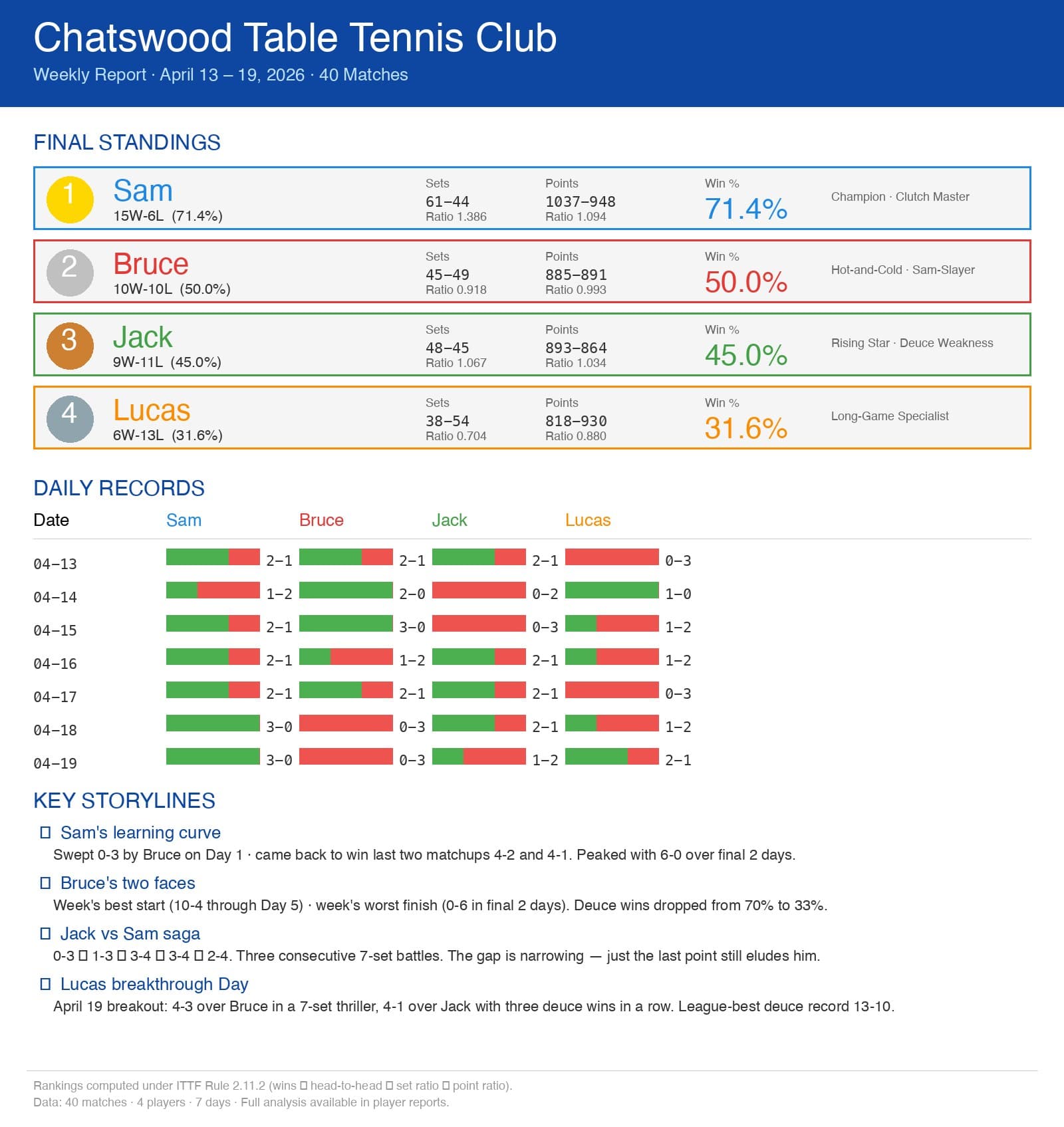
Over the past seven days, from April 13 to April 19, the Chatswood Table Tennis Club hosted one of its most active stretches of internal competition this season. Four players — Sam, Bruce, Jack, and Lucas — played 40 matches in total, adopting an "as-you-play-you-train" approach that turned every session into both a competition and a laboratory.
All rankings were calculated strictly under ITTF Rule 2.11.2, with ties broken by wins → head-to-head → set ratio → point ratio.
Final Weekly Standings
Refer to Cover image for the final standings, however, it tells only the headline. The deeper story is in how each player evolved across the week.
Sam — The Champion Who Learns
Sam's week began in the worst possible way: a straight-sets 0-3 loss to Bruce on April 13. Seven days later, he had swept both April 18 and April 19 at 3-0 each, finishing the week as the clear number one.
What makes Sam's performance remarkable is not that he dominated Jack and Lucas (6-1 against each — expected). It is how he adjusted to Bruce match by match: 0-3, 2-3, 2-3, 3-2, 2-4, 4-2, 4-1. By the final days he had flipped a losing matchup into a winning one — a textbook example of in-competition learning.
Sam also owns the week's most valuable statistic: a perfect 3-0 record in seven-game matches, and a 60% win rate even when losing the first game. Whatever the scoreboard says mid-match, Sam finds his way.
The one remaining task: Bruce is still 3-4 lifetime this week. The champion has one opponent yet to fully solve.
Bruce — Two Faces of One Week
No player's week was more dramatic than Bruce's. Through the first five days he went 10-4, at one point sweeping April 14 and April 15 with a combined 5-0 record. He was the only player with a winning record against Sam, and he delivered it with clutch play — a 70% win rate in deuce games across that stretch.
Then, the last two days: 0-6. His deuce win rate collapsed to 33%. He lost close games that he had been winning all week.
Coaches will want to understand what changed — fatigue, opponent adjustments, or something else. But Bruce's week is not a cautionary tale; it is a blueprint. He proved he can beat anyone in the club, including Sam. Turning that ability into consistency is the next chapter.
Key growth area: Jack remains his hardest opponent (2-5, set ratio 0.500). That's the next puzzle to solve.
Jack — The Rising Star Stuck at the Threshold
By the traditional win-loss measure (9-11), Jack finished third. By underlying technical indicators, he is nearly the club's second-best player. His set ratio of 1.067 and point ratio of 1.034 are both second only to Sam — the technical gap is smaller than the record suggests.
Jack's story this week is about knocking on the door. Against Sam, his progression reads: 0-3, 1-3, 1-3, 3-1 (win), 3-4, 3-4, 2-4. He has taken Sam to three consecutive seven-game matches. He is finding the way.
But the final point keeps getting away from him: 40% win rate in deuce games — the worst on the team — and an 0-2 record in seventh games. Against Bruce, however, he is utterly dominant (5-2, set ratio 2.000).
The message is clear: Jack's technique is already championship-level. What he needs is the mental muscle for the last two points of a tight game.
Lucas — The Long-Game Specialist Awakens
On paper, Lucas's week was tough — 6-13 overall, 1-6 against Sam. But the cumulative numbers hide a fascinating profile.
Lucas leads the entire club in two of the most pressure-sensitive statistics:
Deuce game win rate: 56.5% (league best)
Seventh-game record: 2-0 (perfect)
He is, in other words, the club's best "long-game fighter" — the player who gets stronger as the match drags on. The problem is getting there. When Lucas loses the first game, his match win rate plummets to 9%. That is the single biggest issue for the coaching staff to address.
April 19 was his breakthrough: he beat Bruce 4-3 in a full seven-game thriller, then beat Jack 4-1 with three deuce wins in a row (12-10, 13-11, 15-13). The long-game specialist showed up.
Growth direction: if Lucas can learn to stay steady through the opening two games, he has a shot at the top half. His late-match temperament is already there.
The Rock-Paper-Scissors Structure
An interesting dynamic emerged from the head-to-head data:
Sam dominates Jack (6-1) and Lucas (6-1) but struggles with Bruce (3-4)
Bruce beats Sam (4-3) but gets dominated by Jack (2-5)
Jack crushes Bruce (5-2) but loses to Sam (1-6)
Every player holds the key to another's weakness. No single player has solved everyone, which makes each matchup genuinely unpredictable and each training session genuinely valuable.
Coach's Closing Note
Forty matches. Zero 0-2 comebacks completed. Four distinct tactical personalities emerged. Four specific development paths are now visible.
Sam → refine the last puzzle (Bruce)
Bruce → stabilize under pressure, study Jack
Jack → unlock the decider (deuce, seventh game)
Lucas → rescue the opening (first game, 0-2 recovery)
The point of "as-you-play-you-train" is not to decide who is best — it is to make each player's next opponent need to study them anew. Every one of these four walked out of this week harder to beat than they walked in. Play as ONE Team, learn from each other and Challenge each other to improve all team's play skills.
See you on the table next week. 🏓